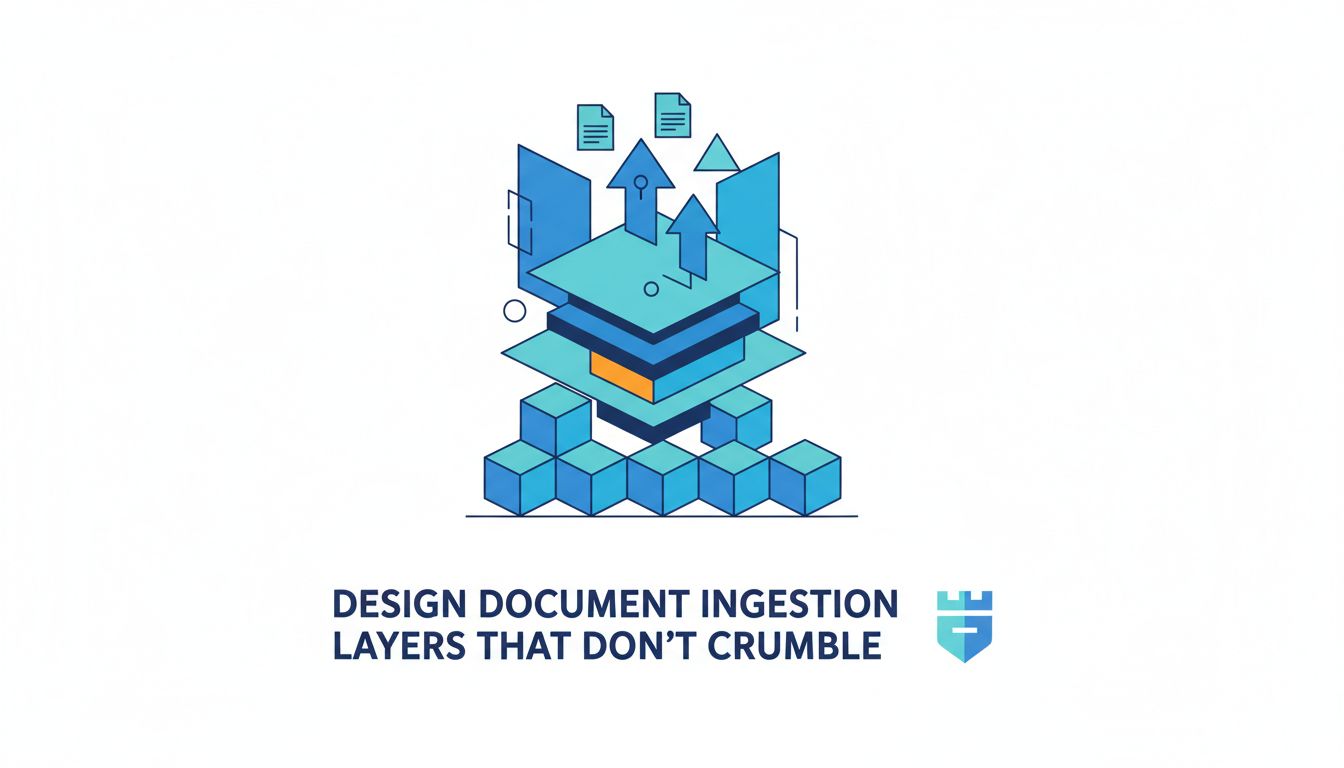
Design Document Ingestion Layers That Don’t Crumble
Your model is not the main problem.
If your AI research app is giving weirdly shallow or flat-out wrong answers, there is a good chance the issue lives below the surface. In the part of your system you probably sketched once, called “ingestion,” then moved on from.
If you want an AI product that still works 6 months and 60 million documents from now, you need to design a document ingestion layer that does not crumble the moment requirements change.
Let’s unpack what that actually means.
What is a document ingestion layer, really?
If you strip away the buzzwords, a document ingestion layer is everything that happens from “user gives you some messy file” to “your retrieval stack has clean, structured, versioned content to work with.”
Most teams think of ingestion as “upload document, extract text, store in vector DB.” That is the toy version.
The real version is closer to: track, transform, enrich, and index content in a way that your models can trust and your future self will not hate.
From raw files to model-ready chunks
Here is the mental model: ingestion has to take content through a few distinct transformations.
- Raw asset. A PDF, PPT, HTML page, code repo, whatever.
- Normalized representation. Clean text, structure, metadata, maybe some layout.
- Model-ready chunks. The smallest useful units of knowledge, with context and provenance.
That last step is where most pipelines fall apart.
Good chunking is not “split every 1,000 characters.” It is closer to: keep logical units together, attach the right metadata, and preserve references. For example:
- A legal contract clause plus its heading.
- A slide bullet plus its slide title and section.
- A code function plus the file path, language, and surrounding comments.
Think of each chunk as a tiny API object your model queries. If those objects are noisy, incomplete, or mis-labeled, no RAG trick will save you.
[!TIP] Start by defining your ideal chunk schema for your app, then design ingestion to produce that, not the other way around.
Where ingestion stops and retrieval begins
It is easy to blur ingestion and retrieval into “the pipeline.” That makes it harder to reason about problems.
A useful line:
- Ingestion answers: “What is in my corpus and how is it stored?”
- Retrieval answers: “Given this query, which pieces should I bring back and how?”
Ingestion is about precomputation. You pay a one-time cost to parse, normalize, enrich, and index, so that retrieval can be fast and predictable.
Once you see that separation, you can debug better:
- Garbled text or missing sections, ingestion problem.
- Irrelevant yet well-formed chunks, retrieval and ranking problem.
- Old versions showing up, ingestion and versioning problem.
If you architect the ingestion layer clearly, retrieval stays simpler and you avoid turning your whole system into a spaghetti mess of “fixes” on top of bad data.
Why your ingestion design makes or breaks AI app quality
You can swap vector databases. You can try 5 different LLMs.
If your ingestion is wrong, all you are doing is changing how creatively the model reasons over bad inputs.
How ingestion errors show up as “dumb” AI answers
Most “the AI is dumb” moments are actually “the AI is blind or misled” moments.
Some classic patterns:
- Missing structure. You extracted text from a PDF but lost headings and hierarchy. The model answers with generic content because it cannot tell what is section-level vs global context.
- Layout confusion. Two-column PDFs, tables, sidebars, footnotes merged into a single stream. The answer pulls table notes as body content or mixes columns into nonsense sentences.
- Crushed context. You split at arbitrary lengths. A policy chunk contains half the conditions and none of the exceptions. The model confidently answers something that is technically false.
- Metadata drift. Chunks have stale tags or wrong permissions. The model shows content from outdated docs or from a team that should not see it.
From the outside, it looks like “LLM hallucination.” Inside, it is the ingestion layer feeding it ambiguous, partial, or mislabeled context.
Once you see this, tuning prompts before fixing ingestion feels a bit like polishing a cracked lens.
The hidden cost of re-ingestion when requirements change
The first version of your app rarely has perfect requirements.
You start with “answer questions over PDFs.” Then real users show up and suddenly you need:
- Time-aware answers. “As of last quarter, what changed?”
- Per-tenant isolation.
- Support for PPT, Confluence, Git repos.
- Redaction for PII.
- Support for 3 different chunking strategies for 3 different use cases.
If your ingestion design is just “parse, chunk, embed, store” glued together, every new requirement looks like:
- Re-parse a mountain of documents.
- Re-chunk everything.
- Re-embed, re-index, and pray you do not break existing behavior.
Re-ingestion is not just compute cost. It is opportunity cost. Your team spends sprint after sprint migrating data instead of shipping features.
A better ingestion layer is built on composable, versioned stages. That way, when requirements change, you can:
- Replay only the stages that changed.
- Upgrade embeddings without re-parsing raw files.
- Keep multiple chunking strategies side by side.
- Audit what changed and why.
This is where tools built specifically for document pipelines, like PDF Vector, start to shine. They reduce the pain surface of evolving requirements.
A practical blueprint for a modern ingestion pipeline
Let’s make this concrete. If you were designing a “sane for v1 yet extensible for v5” ingestion pipeline, what would it look like?
Core stages: acquire, normalize, enrich, index
A helpful blueprint is four core stages.
- Acquire. Get the document, assign it an ID, store the raw asset.
- Normalize. Turn it into structured text plus metadata.
- Enrich. Add semantic and structural signals.
- Index. Break into chunks and push to queryable stores.
Each stage should be explicit, observable, and retryable.
Here is how they differ:
| Stage | Main Question | Example Outputs |
|---|---|---|
| Acquire | Do I have the right raw file? | Blob storage key, source URL, checksum, tenant ID |
| Normalize | Can I read and structure this? | Clean text, headings, page structure, file-level metadata |
| Enrich | What extra context can I compute? | Entities, summaries, classifications, embeddings, labels |
| Index | How do I expose this for retrieval? | Chunk records, vector entries, keyword index, graph links |
If you design ingestion around those questions, it becomes much easier to extend later.
[!NOTE] A clean ingestion layer is as much about boundaries as it is about features. Each stage should know exactly what it owns.
Handling real-world formats: PDFs, slides, code, and web content
Real content is messy. The same user will upload a PDF export, a slide deck, an HTML link, and expect consistent behavior.
Your ingestion should treat these as different adapters behind a common contract.
A few specifics:
- PDFs. Preserve page structure, reading order, and block types (headings, captions, footnotes). Some libraries flatten everything. That is cheaper, and then you pay in answer quality. This is exactly the problem PDF Vector is built to solve: extracting usable structure from PDFs instead of just text.
- Slides. A slide is not a page of a PDF. Title text, body bullets, speaker notes, and slide section all matter. Good chunking keeps the slide as a unit, then annotates with deck-level context.
- Code. Tokens and files are the wrong abstraction. Functions, classes, routes, modules, even test relationships work better. Ingestion should parse ASTs where possible and create meaningful units.
- Web content. Boilerplate, navigation, and cookie banners will happily pollute your corpus if you let them. Use HTML parsing, readability-style extraction, and domain-specific rules to isolate main content.
The pattern that works: format-specific extraction, shared schema.
You want all content, regardless of format, to converge into something like:
{
  "document_id": "...",
  "source_type": "pdf|slides|code|web",
  "sections": [...],
  "metadata": {...}
}
If you do that well, your retrieval and ranking logic can mostly forget about the original format.
Versioning, lineage, and keeping context in sync
You will have to answer questions like:
- “Which version of this document did the model use when it gave that answer?”
- “What changed between v3 and v4 for this policy?”
- “Did we re-embed after we fixed parsing bug X?”
If your ingestion layer cannot answer those, you are flying blind.
You want three kinds of traceability:
- Document versions. Each update is a new immutable version with a pointer to the previous one.
- Transformation lineage. Logs of which parser, models, and configs processed which document version.
- Index state. Which chunks and embeddings correspond to which document version.
A minimal approach:
- Use content hashes to detect real changes.
- Store a
versionandsource_hashin your document records. - Include that version in chunk and embedding metadata.
- When re-ingesting, mark older versions as inactive, but do not delete them immediately.
This is not just for compliance. It is how you avoid “ghost chunks” from old versions leaking into answers.
How to choose between ingestion architectures and tools
Not every team needs a distributed streaming ingestion platform on day one. You do need to choose the right architecture for your load, your latency needs, and your rate of change.
The 3 ingestion archetypes: batch, streaming, and hybrid
Most real systems fall into three patterns:
| Archetype | When it shines | Tradeoffs |
|---|---|---|
| Batch | Periodic syncs, research corpora, backfills | High latency, simple to reason about |
| Streaming | User-facing uploads, real-time updates, events | More infra, better freshness and observability |
| Hybrid | Mix of scheduled jobs and event-driven updates | More moving parts, best balance for growing apps |
Some examples:
- Internal research tool over static PDFs. Nightly batch re-ingestion is fine.
- Customer support assistant over live tickets and KB. Streaming ingestion so updates appear in minutes.
- SaaS AI workspace for documents across many connectors. Hybrid, with streaming per-user uploads and batch syncs from external systems.
The trick is to design your pipeline stages to work in both modes. The same “normalize → enrich → index” logic can be run as a job or as a queue-driven worker.
Build vs buy: decision criteria for dev teams
You can absolutely build ingestion yourself. Many teams do. A few months later they realize that PDF parsing, error handling, and re-indexing are not where they want to spend their creativity.
You should build your own ingestion stack if:
- Your content formats or compliance needs are highly custom.
- You have infra experience and want tight control.
- Ingestion is core IP, not plumbing.
You should strongly consider a platform or product like PDF Vector if:
- Your main formats are PDFs, office docs, and web.
- You want strong extraction, chunking, and vectorization without building it from scratch.
- You need versioning, lineage, and operations dashboards quickly.
A simple way to decide:
What percentage of my engineering effort do I want going into ingestion vs product features?
If “less than 20%,” then buying or integrating a specialized ingestion layer is usually cheaper long term.
Framework: optimize for speed, quality, or flexibility
You cannot maximize everything at once. Pick a primary axis.
- Speed-first. Get something working for a demo or early pilot. You accept rough parsing and simplistic chunking to hit a date. Use this when validating demand.
- Quality-first. You care most about answer accuracy in a narrow domain. You are willing to spend more per document and tune parsers deeply. Common in legal, finance, and healthcare.
- Flexibility-first. You know requirements will evolve, many source systems will show up, and your schema will morph. You invest in generic pipelines, metadata, and re-ingestion strategies.
Here is how that choice shifts design:
| Priority | Typical Choices |
|---|---|
| Speed | Single vector store, basic chunking, minimal metadata |
| Quality | Format-specific parsers, domain chunking, rich enrichment |
| Flexibility | Strong versioning, pluggable stages, multiple indices |
Most production teams end up aiming for quality + flexibility. They move fast on v1, then refactor ingestion around a platform or framework once the product shows promise.
PDF Vector explicitly targets that zone. You get higher-quality document structure without giving up control of your pipeline.
Designing for the future: scale, governance, and change
If your product works, your ingestion layer will eventually be asked to do 10 times more, for 10 times more users, with 10 times more constraints.
Better to design for that a bit earlier.
Cost control strategies as document volume explodes
Vectorization, enrichment models, and storage are where your bill sneaks up.
Some practical levers:
- Deduplicate aggressively. Use hashes to avoid re-processing identical or trivially changed documents.
- Stage your models. Use cheaper models for broad enrichment, expensive models only where necessary. For example, cheap embeddings for keyword-like search, expensive for a “golden index.”
- Selective enrichment. Not every doc needs every annotation. Runtime routing based on document type, size, or tenant plan can cut costs materially.
- Archive rarely used stuff. Move cold documents out of your main index but keep a slower path to rehydrate them on demand.
Cost control is not only about cheap compute. It is about designing ingestion to make smart decisions about work.
Schema evolution, redaction, and compliance concerns
Your first schema will be wrong. Not because you are bad at design, but because your users will ask for things they did not think of at the beginning.
Your ingestion should assume schema evolution will happen.
A few patterns that help:
- Use schema versioning on your chunks and documents.
- Keep metadata extensible. Namespaces like
system.*,user.*,compliance.*can reduce collisions. - Treat PII and secrets as first-class citizens. Redaction is not a regex you bolt on at the end. It should be a stage in ingestion with its own logs and controls.
For regulated domains, you will also need:
- Clear lineage, which we covered earlier.
- The ability to delete or anonymize all references to a given entity, across documents and indices.
- Configurable retention policies that affect both raw and processed content.
This is another area where outsourcing part of ingestion, or using something like PDF Vector as your “document brain,” can make your life saner. You leverage what is already battle-tested instead of guessing your way through compliance.
Testing and observability for ingestion in production
You would not ship application code without tests and monitoring. Ingestion deserves the same respect.
Some useful practices:
- Golden documents. Maintain a small corpus of tricky, representative documents. Every time you change parsers or chunking, re-ingest them and compare structured outputs to expected snapshots.
- Diffing pipelines. When you upgrade a model or parsing library, run both old and new pipelines on a sample and compute diffs at the chunk and field level.
- Ingestion metrics. Track rates of failures, partial successes, and per-stage latencies. If parsing errors spike on a new format, you want to know before users complain.
- Content-level checks. Heuristics like “average chunk length,” “percentage of chunks with headings,” or “fraction of documents with zero extracted text” catch subtle breakages.
[!IMPORTANT] Ingestion bugs are often silent. Your system “works” but answers degrade. Observability for ingestion is not a nice-to-have, it is how you avoid slow-motion data corruption.
Where to go from here
If you remember nothing else, remember this:
Your document ingestion layer is not a piece of glue. It is the foundation of your AI product’s understanding of the world.
Design it like you will have to live with it for years, because you probably will.
Concretely, your next steps could be:
- Sketch your current ingestion as the four stages: acquire, normalize, enrich, index. Mark what is implicit or tangled.
- Decide which axis you are optimizing on right now: speed, quality, or flexibility.
- Pick one pain point, such as PDF parsing or re-indexing on change, and improve that with a more robust tool or pattern. This is where bringing in something like PDF Vector for the document-heavy parts of the pipeline often pays for itself quickly.
From there, you can evolve toward an ingestion layer that supports the product you actually want to build, not just the prototype you hacked together.
Your models will look smarter. Your infra will hurt less. And your future self will send you a quiet thank you.