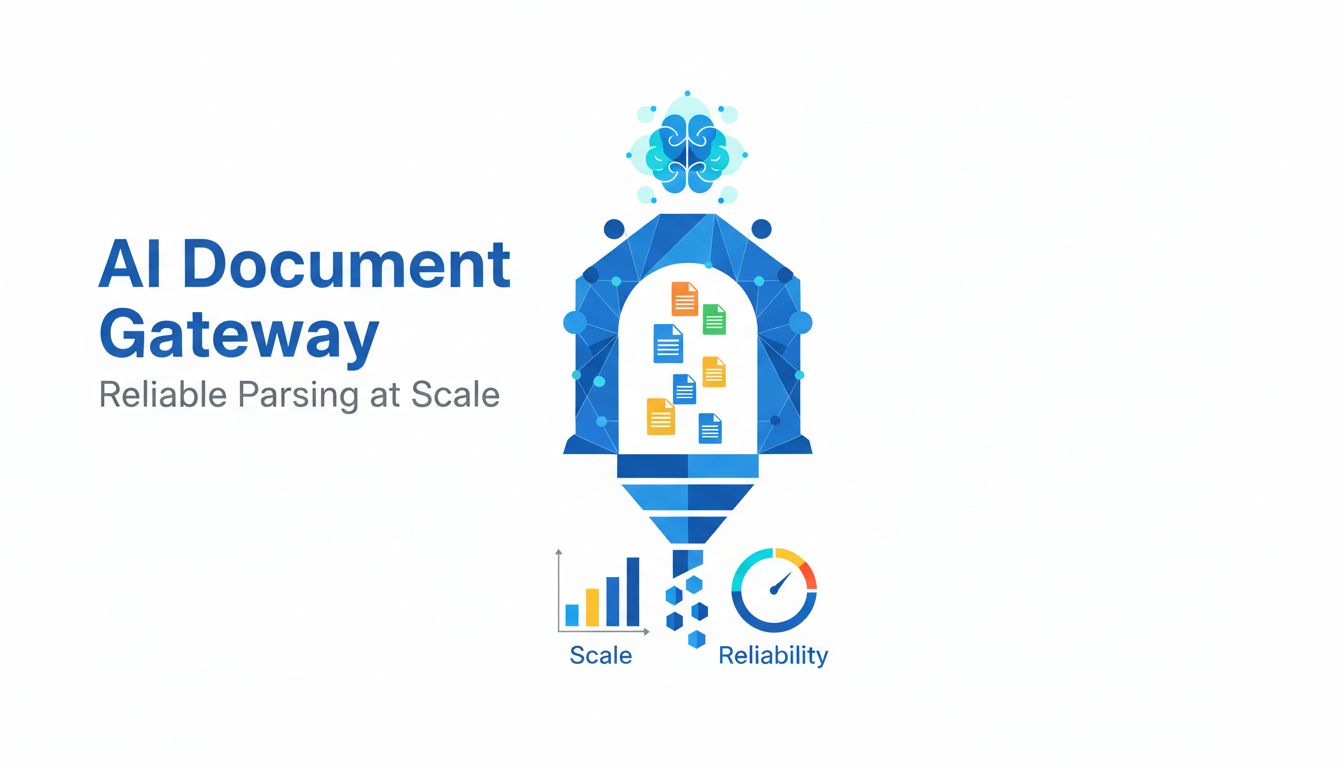
AI Document Gateway for Reliable Parsing at Scale
Your users assume your product understands documents as well as a human.
They drop in a 40 page PDF export from some ancient ERP, click "Upload", and expect structured data, instant search, analytics, and insights. If your system quietly chokes on one weird invoice template or that one HR form from 2013, they will not blame the PDF. They will blame your product.
That gap between expectation and reality is why an ai document gateway suddenly matters.
Not because "AI" is trendy. Because your document pipeline has become core infrastructure, and you are probably still treating it like a side quest.
Let’s fix that.
Why an AI document gateway suddenly matters for your roadmap
Product expectations have shifted faster than your parsing stack
Five years ago, "upload a PDF and maybe get a preview plus a few fields" felt fine.
Today, your buyers compare you to tools that can:
- Ingest any document format from any source
- Normalize messy layouts
- Extract entities, tables, signatures, and metadata
- Let users query "all invoices where payment terms changed last quarter"
And they expect it to "just work" across everything they throw at you.
Internally, though, many teams still have:
- A single PDF parsing service that calls one model or one library
- A patchwork of regex and handwritten templates
- Zero visibility into how often parsing quietly fails
You can scale that to a point. Then the edge cases start to eat your roadmap.
An AI document gateway is basically your admission that documents are no longer a feature. They are a platform capability that needs its own layer, policies, and roadmap.
Why document reliability now affects revenue, not just UX
Parsing used to be a "nice to have". If it failed, someone manually keyed in the data and life went on.
Now your contracts and revenue are tied to what your system understands correctly.
Imagine these scenarios:
- You sell a workflow product that routes contracts based on key clauses. One misparsed renewal date triggers a missed auto renewal. That is lost ARR, not a minor bug.
- You power analytics on top of uploaded financial statements. If parsing drops a few rows or misreads a column, customers make bad decisions. They will not blame their PDFs. They will churn.
- Your SLAs promise "ingestion of any document within 5 minutes". Parsing failures that require manual intervention eat support time and SLA buffers.
Parsing reliability has become part of your value proposition.
If your product story is "we automate your document-driven process", then parsing is not a backend detail. It is deeply tied to:
- Churn
- Expansion (more document types = more seats, more workflows)
- Enterprise deals that live or die on SLAs
That is what an AI document gateway protects.
The hidden cost of rolling your own document parsing
Edge cases, brittle regex, and the maintenance tax on engineers
Almost every team goes through the same journey.
Phase 1: "How hard can it be? We just need to pull 6 fields from this PDF."
Phase 2: You ship a small service that uses a library and some regex. It works on your test set. The team celebrates.
Phase 3: Customers start uploading:
- Scans with skewed text
- Multi language invoices
- New layouts from vendors who "updated their template"
- 100 MB PDF exports with nested tables and footers that look like data
Your regex tree grows into a forest. You add special cases, layout heuristics, per customer "profile types."
Every new customer means more parsing logic. Your senior engineers become part time PDF therapists.
[!NOTE] The true cost is not building the first version. It is owning every "just one more format" request for the next 3 years.
There is also the innovation tax.
Time spent extending brittle parsing logic is time not spent on:
- New workflows
- Better collaboration features
- Deeper analytics
- Performance improvements customers actually notice
Document parsing feels like infrastructure. It behaves like a product you never wanted to build.
How silent parsing failures erode customer trust and SLAs
The most dangerous failures in document systems are not the ones that throw a 500.
It is the silent ones.
A few examples:
- OCR misreads "1.00" as "100" in a financial report. No error is raised. Your system happily stores wrong data.
- A contract parser misses an auto renewal clause in one edge case layout. Everything else parses fine. That customer only notices when a renewal is missed.
- Your API returns a partially filled JSON with no confidence scores or warnings. Downstream processes treat it as ground truth.
You might still be hitting your uptime SLA.
But your data quality SLA, the one everyone assumes but no one writes down, is broken.
Here is how that plays out:
| What happens internally | What the customer experiences |
|---|---|
| Parser returns incomplete or wrong fields | Dashboards look wrong, workflows mis-route |
| No confidence scores or error flags | They assume data is correct until it burns them |
| Support handles issues as one-offs | They start "not trusting" the system |
| Engineering treats issues as corner cases | Sales finds objections on "data reliability" grow |
Once customers start saying "we double check everything your system outputs", your value story is already damaged.
An AI document gateway exists to make failure modes explicit, observable, and controllable. Not just "less frequent."
What an AI document gateway actually is (in practical terms)
From single PDF endpoint to policy-aware gateway
Most teams today have something like this:
/parse-pdf → single service → single strategy → JSON
An AI document gateway turns that into:
Entry point One consistent endpoint for "document in, structured data out," regardless of:
- File type
- Source system
- Customer specific templates
- Chosen model/vendor
Policy layer Rules that decide, for each request:
- Which parsing strategies to try in what order
- What to do when confidence is low
- When to route to a different model, template, or engine
- How to log and surface issues
Abstraction Your product and microservices do not care if a given document was parsed by an LLM, a template, a custom model, or a vendor like PDF Vector. They just see a contract that the gateway enforces.
So instead of a thin "proxy to some OCR API," the gateway behaves more like an API gateway for documents, with policies and orchestration.
How a gateway orchestrates models, templates, and fallbacks
Think of the gateway as the brain that chooses and combines tools.
A practical flow might look like this:
Ingestion and classification The gateway receives the document, detects file type, maybe classifies it as "invoice," "contract," "bank statement," "unknown".
Strategy selection Based on the type, customer, and policies, it chooses a parsing path. For example:
- Try a template based parser for known invoice formats
- If template confidence is low, fall back to an LLM based layout aware parser
- If the document is an image, route first through OCR, then to downstream extractors
Execution and combination It may run multiple strategies in parallel. For example, one model for tables, another for key value pairs. Then merge the results with a confidence model.
Validation and normalization Before anything leaves the gateway, it validates against schemas or business rules. Dates must parse. Amount columns must sum correctly. Identifiers must match regex or reference lists.
Decision on failure modes
- If results meet confidence thresholds, return success
- If not, flag partial results, add warnings, or require human review based on policy
This is the practical win.
Instead of wiring your product to "Model X" or "Library Y," you wire to the gateway. Then you are free to:
- Swap out models
- Refine templates
- Add new parsers from vendors like PDF Vector
- Change fallbacks and thresholds
All without touching the product teams who consume the data.
[!TIP] The job of the gateway is not to be "smart." Its job is to make your system predictable around something that is inherently messy.
How product and engineering teams plug a gateway into their stack
Designing clear contracts: inputs, outputs, and confidence scores
If you get this part right, everything else becomes easier.
Your gateway should speak in contracts, not vibes.
On the input side, define:
- What metadata must be provided. Document type hints, customer ID, region, any known schema.
- What constraints matter. Maximum file size, page limits, supported formats, timeouts.
On the output side, be explicit:
- What the top level schema looks like (even if some fields are optional).
- How nested structures are represented. Tables, line items, clauses.
- How confidence is expressed. Per field scores, overall document confidence, and any flags.
A good pattern looks like this:
{
  "document_id": "abc123",
  "type": "invoice",
  "fields": {
    "invoice_number": { "value": "INV-2049", "confidence": 0.98 },
    "due_date": { "value": "2026-01-15", "confidence": 0.92, "warnings": [] },
    "total_amount": { "value": 1025.70, "confidence": 0.88, "warnings": ["inconsistent_sum"] }
  },
  "tables": [
    {
      "name": "line_items",
      "confidence": 0.91,
      "rows": [ /* ... */ ]
    }
  ],
  "raw_text": "...",
  "errors": [],
  "processing_metadata": {
    "strategies_used": ["template_v3", "llm_layout_2"],
    "processing_time_ms": 1340
  }
}
This lets consuming services make smart decisions:
- An approval workflow can enforce "do not auto approve if any monetary field is below 0.9 confidence."
- A UI can show which fields might need human review.
- Analytics can filter out low confidence documents.
PDF Vector, for example, is often used as a backend parsing engine inside a gateway like this. The gateway normalizes its outputs (and those from other engines) into a consistent contract so your teams are not juggling vendor specific JSON shapes.
Observability, QA loops, and owning the failure modes
If your gateway is a black box, you just created a larger version of the problem you started with.
You need first class observability:
- Parse success rate per document type and per customer
- Distribution of confidence scores over time
- Error categories. Timeouts, classification errors, schema validation failures, model errors.
- Drift signals. For example, a sudden spike in "unknown layout" for a known customer.
This is where the best teams start treating their document parsing like a living system.
They do things like:
- Set SLOs not just for uptime, but for "parse success with confidence ≥ X" per document type.
- Build feedback loops from support and users into training data or template updates.
- Run shadow deployments for new strategies, compare against current behavior, then promote.
[!IMPORTANT] You cannot avoid failure modes. You can only choose whether you discover them in production, through angry customers, or in your own telemetry and QA loops.
A practical pattern:
- Gateway logs all parsing attempts with anonymized samples or structured summaries.
- A QA or data team regularly reviews low confidence or high error segments.
- They label failures that matter. Wrong totals, missed clauses, layout misclassification.
- Engineering uses that signal to refine rules, retrain models, or add new strategies.
Over time, the gateway becomes smarter not by "adding more AI," but by systematically closing the loop between reality and assumptions.
Looking ahead: turning documents into a product advantage
From parsing to understanding: enrichment, search, and analytics
Once you have a stable AI document gateway, something interesting happens.
Parsing stops being the bottleneck. It becomes a foundation.
You can start asking more ambitious questions:
- If we normalize every invoice we have ever seen, what pricing patterns emerge?
- If contracts are parsed into structured obligations, how can we predict renewal risk?
- If we enrich documents with embeddings and entities, can we offer natural language search across everything a customer has ever uploaded?
Parsing then feeds:
- Search. Semantic search across document content, not just file names and tags.
- Recommendations. Suggest next actions based on similar documents and outcomes.
- Analytics. Real benchmark data, not whatever customers manually typed in.
This is where products differentiate.
Two competitors might both "support PDF uploads." The one with a robust gateway can layer insights and workflows that feel magical, because the underlying data is complete and trustworthy.
PDF Vector fits in nicely here as a backbone for extraction and vectorization. You plug it into the gateway, let it handle low level document intelligence, then build the visible magic in your product.
What teams that win with documents will be doing next
The teams that turn documents into a real moat tend to share a few behaviors.
They:
- Treat the AI document gateway like a core internal platform, not a helper service.
- Involve product, data, and support in defining what "good parsing" actually means for their business.
- Make confidence, errors, and lineage visible to users, not just engineers.
- Continually expand the set of document types they understand deeply, not just superficially.
They also stop thinking in "document types" and start thinking in contracts and events.
A contract is not just "a contract PDF." It is:
- A set of parties
- A renewal and termination model
- A bundle of obligations and rights
- A set of events over time, like approvals, amendments, renewals
Once your gateway can consistently turn messy files into that kind of structure, you are no longer playing the "who parses PDFs better" game.
You are playing the "who understands the customer's business better" game.
That is where the real margin lives.
If your team is starting to feel the pain of inconsistent parsing, brittle customer specific hacks, or growing demands around document intelligence, it is probably time to define your own AI document gateway.
Whether you build it from scratch or lean on tools like PDF Vector for the heavy lifting, the key move is the same. Stop wiring your product directly into low level parsers. Start treating documents as a first class platform concern, with policies, contracts, and feedback loops.
Your users already expect your product to understand their documents. The only question is whether your architecture is set up to keep that promise at scale.