Most teams underestimate how hard it is to make PDFs searchable in a way that scholars actually trust.
You start with a simple goal: "just extract text." Then you ship your academic search, users search for "Bayesian optimization in high dimensions," and the one paper that actually matters is buried because the method section turned into OCR soup. Now your team is debugging font encodings while your competitors ship features.
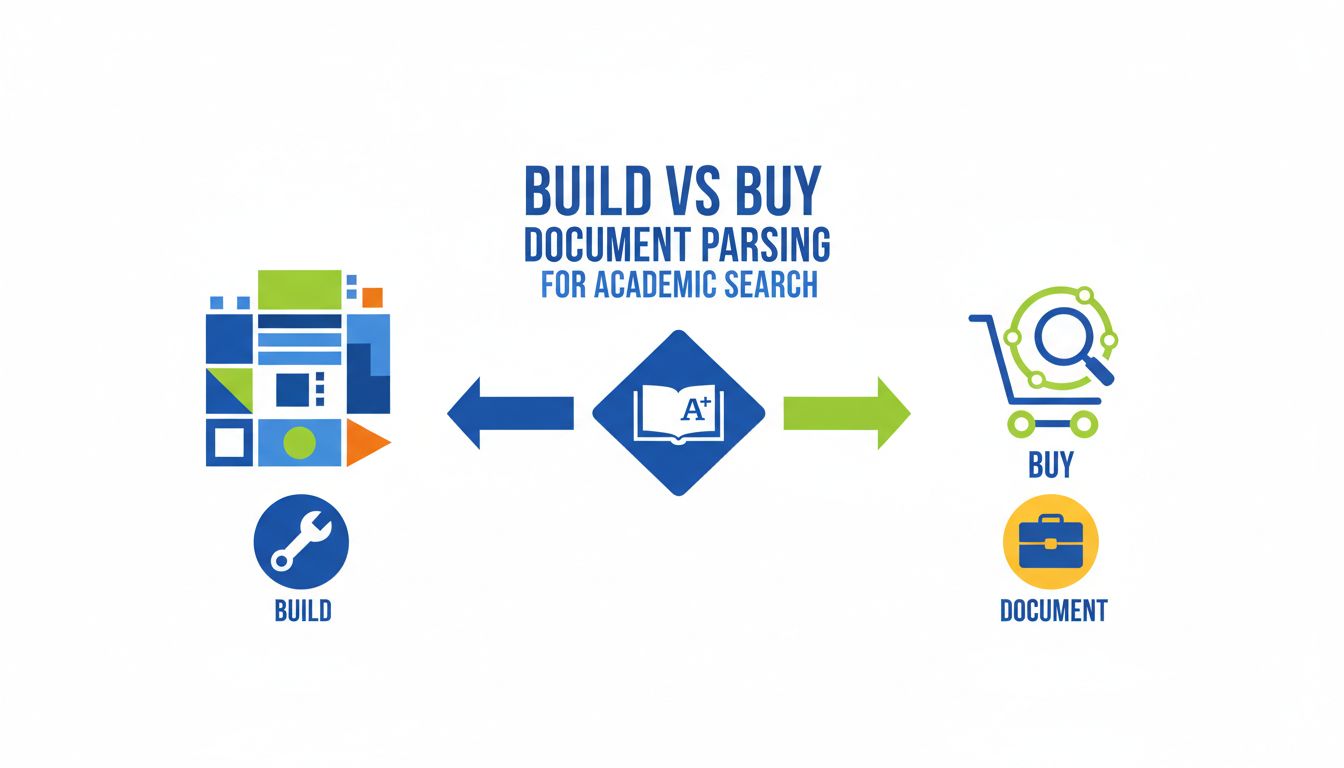
This is where the build vs buy document parsing and academic search decision becomes real. It is not about saving a few cents per document. It is about whether your search product has a reliable foundation or a quiet failure mode that erodes trust.
Let’s walk through this like a real decision, not a theoretical pros and cons list.
What problem are you really solving with document parsing?
From "just extract text" to powering accurate academic search
If all you needed was a blob of text for full-text search, you could stop at Apache Tika and move on with your life.
Academic search is different. Users are rarely searching for generic keywords. They look for:
- Specific methods and equations
- Named datasets and benchmarks
- Citations and authors
- Section-specific content like "results" or "limitations"
That means parsing is not just "read the text from the PDF."
You are really trying to build a structured representation of scholarly documents:
- Sections, headings, and hierarchy
- References, citations, and their links
- Tables and figures and their captions
- Equations and symbols
- Metadata like DOI, journal, conference, language
Imagine two search engines on the same corpus:
- Engine A has only flat text. Section headings are mixed with body text, references are inline noise, equations are random characters.
- Engine B has structured fields. It knows what is in the abstract, methods, results, and bibliography. It can boost by citation count, filter by dataset, and highlight math expressions correctly.
The relevance of your ranking is mostly determined before search even starts. It is decided at parsing time.
How parsing quality shapes ranking, recall, and user trust
Parsing quality is invisible when it works. It is painfully visible when it fails.
You see it in three places.
Ranking. If your parser misses half the equations in methods sections, your ranking skews toward papers with simpler typography, not better relevance. Your ranking model then "learns" from biased data.
Recall. Academic users are often trying to find "the one paper" they know exists. If that PDF had a weird font, embedded scanned pages, or a complex table layout, a weak parser will silently drop key terms. To the user, your search is "wrong," not your parser.
User trust. Researchers test systems by poking at the edges. They try rare authors, specific acronyms, exact phrases from PDFs they have on their desktop. If your search misses obvious matches, they stop using filters, then they stop relying on your platform.
[!NOTE] Every parsing mistake is a small act of gaslighting. The paper exists. The user knows it. Your system says it does not.
So the real problem is not "Should we read PDFs ourselves or use an API." The real problem is "Can we afford to have our core relevance signals built on fragile extraction."
The hidden cost of building your own parsing stack
Engineering time, maintenance, and the opportunity cost of not shipping features
Most teams that choose to build have a similar starting story.
Someone says, "We can hook up an open source library in a sprint. How hard can it be."
The first 80 percent is easy. The last 20 percent takes the next two years.
Here is what "build your own parsing" actually turns into:
- Initial integration with PDF libraries
- Wrangling text encodings, ligatures, and broken fonts
- Handling weird layouts in conference proceedings vs journals
- Layering in OCR for scanned PDFs
- Detecting headers, footers, and page numbers and stripping noise
- Identifying sections and references with heuristic rules
- Maintaining all of this as you see new document types
Meanwhile, product asks for:
- Better author disambiguation
- Support for preprints from new repositories
- More filters and facets
- Embedding search, semantic ranking, recommendations
You now have a choice every quarter. Fix parser bugs or ship user-facing features.
Parsing becomes a permanent tax on your roadmap.
Edge cases that quietly break: equations, tables, references, and scans
Parsing is not hard because of the average document. Parsing is hard because of the outliers your users care about the most.
- Equations. LaTeX-generated PDFs, inline vs display math, symbol fonts. Extracting "x̂" and "σ²" correctly is nontrivial. Getting TeX-like representations is harder.
- Tables. Multi-column tables, merged cells, rotated headers, nested tables. If you get tables wrong, downstream features like dataset search and metrics extraction are unreliable.
- References. Citations appear in dozens of formats. Even within one journal. Detecting references, author lists, titles, and DOIs is its own project.
- Scans. Legacy journals, theses, and older conference proceedings often exist only as scanned images. Without robust OCR and layout detection, those are dead documents in your index.
These are not rare.
Look at any academic corpus at scale. You will find tens of thousands of these edge cases in the first few million documents.
And they do not fail loudly. They fail quietly. You only see them when a user complains or when you manually inspect samples.
[!TIP] A quick internal test: randomly sample 200 PDFs from your corpus, hand inspect how equations, tables, and references look after parsing, and estimate how much engineering time it would take to fix each type of error systemically.
Security, compliance, and scale: the parts nobody budgets for
Parsing academic documents is often done on content that is:
- Licensed from publishers
- Tied to institutional access
- Sometimes sensitive (e.g., grant documents, internal reports, preprints under embargo)
If you build in-house, you own:
- Security hardening. Sandboxing parsers, avoiding RCE vulnerabilities in PDF libraries, validating file types.
- Compliance. Data residency, access controls, audit logs, GDPR and institutional agreements.
- Operational scale. Queues, backpressure, retries, timeouts, cost controls for OCR, monitoring, observability.
- Performance. Parsing millions of PDFs without slowing ingestion or blowing your cloud budget.
Most engineering teams do not budget for this upfront. Then they discover that parsing is in the critical path for every ingestion pipeline and incident.
When you buy, some of this is effectively outsourced. Not magically solved, but at least handled by a team whose entire job is to do this well.
A vendor like PDF Vector, for example, lives or dies by parsing reliability and security. You get the benefit of an infrastructure and compliance investment that would be overkill for any single product team.
When does it actually make sense to build instead of buy?
Signal that you should own the parsing layer in-house
There are cases where building your own parsing stack is absolutely the right call.
Strong signals:
- Parsing is strategic IP. Your product is document understanding. For example, you specialize in extracting experimental setups from chemistry papers, or you sell parsing itself as a core capability.
- You have a dedicated ML / NLP team. Not one or two engineers maintaining scripts, but a team whose roadmap is parsing quality, models, and layout understanding.
- You control the document format. For example, your platform mandates LaTeX sources or a single publisher’s PDF template. Low variability changes the calculus.
- You need extremely custom representations. Parsing is tightly coupled with proprietary downstream models that rely on very specific intermediate structure.
In those scenarios, owning the layer can be a competitive advantage. You can experiment faster, tune to your niche, and avoid vendor constraints.
The mistake is assuming every academic search product falls into this category.
Scenarios where a specialized vendor is the smarter choice
For most B2B SaaS teams building academic or scholarly search, buying is not an admission of weakness. It is good portfolio management of your engineering time.
Buying tends to win when:
- Your core value is search, discovery, or analytics, not parsing itself.
- Your document sources are diverse. Multiple publishers, preprint servers, conference PDFs, scanned archives.
- You need to move quickly. For example, you are under pressure to launch a new academic vertical or support a new content partner this quarter.
- Your team is small enough that losing 1 or 2 senior engineers to parsing maintenance would hurt your roadmap.
Here is what that looks like in practice.
A research collaboration platform wants to add full-text search over uploaded papers and project reports. Their differentiator is collaboration, recommendations, and workflows. They choose to integrate a vendor like PDF Vector to handle parsing and embeddings. Their team focuses on ranking, UX, and integrations with institutional identity systems.
They ship a working, reliable search in weeks, not months, and can spend their energy on what makes them different.
Hybrid approaches: extending a vendor instead of starting from zero
There is also a middle path that is underused.
You do not have to choose "100 percent vendor" or "100 percent in-house."
A hybrid strategy often looks like:
- Use a vendor for the general parsing: text extraction, layout, citations, tables, math.
- Build custom logic on top: domain-specific tagging, dataset entity extraction, risk classifiers, specialized embeddings.
- Keep a small in-house pipeline for niche sources or highly constrained formats where you can do better than the vendor.
This gives you:
- Faster time to market
- A solid baseline that improves as the vendor improves
- Room to differentiate on domain understanding rather than layout archaeology
You can also design your architecture so that swapping vendors is possible. That way, you keep leverage and avoid lock-in, while still not spending your life debugging PDFs.
How to fairly evaluate document parsing APIs for academic use
Designing a realistic benchmark: corpus, formats, and success metrics
Vendor demos look great. Your corpus does not.
If you want a fair evaluation, you need a benchmark that looks like your real world.
Build a test set with:
- A mix of publishers, conferences, and preprints
- At least some scanned or partially scanned documents
- Documents with heavy math, complex tables, and dense references
- Multiple languages if your product will see them
Then define success in operational terms that match your product:
- "Can we accurately identify abstract, introduction, methods, results, discussion, conclusion"
- "Can we extract references with author, title, venue, and year at X percent accuracy"
- "Do equations come out as recognizable text or structured markup"
- "Are tables machine readable, with correct rows and columns"
You do not need a PhD-level evaluation. You need to know, for your use case, whether the parser makes your search credible.
[!IMPORTANT] If a vendor cannot run a small custom evaluation on your sample corpus, or refuses to, that is a signal. Parsing quality is too central to treat as a black box.
Must-have capabilities: citations, math, tables, and multilingual support
For academic search, some parsing features stop being "nice to have" and become baseline requirements.
You should expect:
- Citations and references. Accurate detection and structuring. Ability to link in-text citations to bibliography entries.
- Math-aware parsing. Equations preserved as meaningful strings, not random Unicode. Bonus points if there is a consistent representation suitable for indexing or embeddings.
- Table extraction. Tables as structured data, not fused text. Headers recognized, row and column boundaries respected.
- Multilingual support. At least correct text extraction and basic structure for non-English documents. Ideally, no catastrophic failures on common academic languages.
- Layout understanding. Separation of main content from headers, footers, page numbers, and marginalia.
If your users care about specific metadata like DOIs or funding acknowledgements, include that in your benchmark as well.
Vendors like PDF Vector often come with these academic-specific capabilities tuned out of the box, which is a big jump over generic PDF extraction APIs.
Proof, not promises: SLAs, roadmap alignment, and vendor reliability
Parsing is not a one-time integration. It is an ongoing dependency.
Evaluate vendors on:
| Area | What to look for | Why it matters |
|---|---|---|
| SLAs | Clear uptime and latency guarantees, documented limits | Parsing in your ingestion pipeline cannot be the bottleneck |
| Versioning | Stable APIs, changelogs, versioned models | You need predictability for long-term indexing jobs |
| Roadmap | Willingness to share what they are improving, especially for academic use cases | You want a partner, not a static tool |
| Observability | Logging, error codes, statistics on failures | Critical for debugging and quality monitoring |
| Support | Real engineering support for tricky documents, not only generic tickets | Academic PDFs will break things, you need help fast |
Ask very direct questions.
- "What happens when your parser fails a document. How do we detect and recover."
- "How often do you update your models. How do you communicate breaking changes."
- "Can we influence your roadmap if we commit to a partnership."
This is where smaller specialized vendors can outperform generic cloud offerings. A team like PDF Vector can be opinionated on academic content and responsive to your edge cases.
A practical decision checklist and what to do next
Five questions to align product, engineering, and leadership
When you are close to a build vs buy decision, put everyone in the same room and answer these, explicitly:
- What is our real differentiation. Are we trying to win on search UX, workflows, insights, or on being the best parser in the world.
- What happens if parsing quality is mediocre. Is that an acceptable risk, or does it undermine our whole value proposition.
- Who will own parsing quality over the next 2 years. Name a person or team. If you cannot, you probably should not build.
- What is the cost of delaying other roadmap items by 3 to 6 months. Be honest. That is what investing in a bespoke parser will likely do.
- Do we have a graceful exit strategy. If we build and later decide to switch to a vendor, or vice versa, how painful will that migration be.
If, after this conversation, parsing still feels like core IP, building may make sense.
If not, you likely want to buy, then customize on top.
Implementation path: pilot, integration plan, and rollout milestones
Once you lean toward buying, do not jump directly to a 2‑year vendor lock-in. Run a disciplined plan.
Pilot. Pick one or two vendors. Integrate minimally. Parse a representative sample of your corpus. Evaluate against your benchmark. Collect both quantitative metrics and qualitative feedback from internal users.
Integration plan. Decide where parsing sits in your architecture.
- Are you parsing at ingestion time and storing structured outputs.
- Or calling the API on demand, for example for user uploads. Define how you will handle retries, failures, and monitoring.
Rollout milestones.
- Phase 1: Limited subset of content or a beta user group.
- Phase 2: Full corpus for one content source.
- Phase 3: All sources, plus retroactive reprocessing of older documents if needed.
During each phase, watch error rates, search quality, and infrastructure costs. Adjust configs and, if the vendor supports it, tune parsing profiles.
Vendors like PDF Vector can often help with best practices learned from other academic customers, which shortens this cycle significantly.
How to de-risk your choice with a time-boxed experiment
If you are still torn between build and buy, do a strict, time-boxed experiment.
For example:
- Give your engineering team 4 weeks to stand up a minimal viable in-house parser using open source tools on a subset of your corpus.
- In parallel, integrate a vendor in 2 weeks on the same subset.
- Compare both against the same benchmark and success criteria.
Track:
- Parsing quality metrics
- Engineering hours actually spent
- Impact on other roadmap items
- Team appetite to keep owning the in-house solution
You will usually find one of two outcomes:
- Your team loves the parsing work, you see a plausible path to parity or better, and leadership is willing to invest. That is a green light to build.
- Or, you realize a vendor is already at a quality level that would take you a year to match, and your engineers are more excited to build features on top.
Either way, you are no longer guessing. You have data and a shared understanding.
If you are at the point where you need to make a call in the next quarter, treat parsing as the foundation it is, not a line item.
Get a realistic benchmark. Ask hard questions. Be honest about your appetite to own a messy, never finished problem.
And if you want to see what a specialized academic parsing stack looks like in practice, take a small slice of your corpus and run it through a vendor like PDF Vector. Compare it against whatever you have now.
The next step is simple. Pick 100 to 200 of your nastiest PDFs, define what "good" looks like for your search, and run a short bake-off. After that, the build vs buy decision usually becomes very clear.